

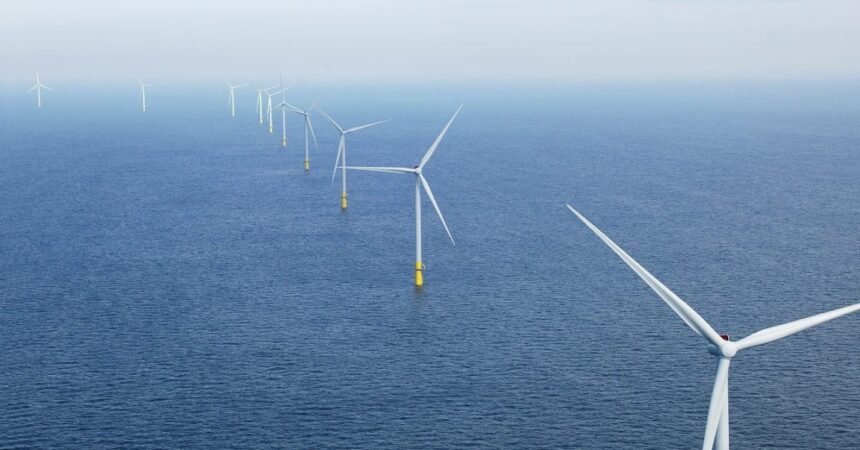
The New York State Public Service Commission (PSC) recently made the decision to halt the current planning process for offshore wind power lines. This decision comes as a result of the Trump administration freezing the permitting of new offshore wind projects, creating uncertainty around the timeline for moving forward with these projects.
The PSC chair, Rory Christian, emphasized the importance of protecting consumers in light of this uncertainty. The commission has withdrawn its Public Policy Transmission Need determination in order to prevent ratepayers from shouldering the cost of building transmission lines for wind farms that may not be operational anytime soon.
The transmission planning effort, known as the PPTN process, was initially launched in 2023 with the goal of connecting up to 8 gigawatts of offshore wind to New York City by 2033. However, with the current federal restrictions on offshore wind projects, the PSC has decided to put these plans on hold.
While the process is being paused, it is not being abandoned entirely. The state plans to resume the planning process once the federal government lifts the freeze on leasing and permitting for offshore wind projects. This delay does not impact offshore wind projects that already have permits in place.
Despite the setback in transmission planning, New York still boasts the largest offshore wind pipeline in the country. Projects like the 132-megawatt South Fork Wind, the 816 MW Empire Wind project led by Equinor, and Ørsted’s 924 MW Sunrise Wind project are all moving forward and expected to provide clean energy to hundreds of thousands of homes.
Although the federal restrictions have slowed down the transmission planning process, New York’s commitment to offshore wind energy remains strong. The state is now working on a longer timeline to ensure the successful implementation of these projects in the future. The COVID-19 pandemic has brought about significant changes to the way we live our lives. From social distancing to mask-wearing, the virus has forced us to adapt to a new normal. One of the most noticeable changes has been the shift towards remote work.
Remote work, also known as telecommuting or telework, has become increasingly popular as companies implement work-from-home policies to keep their employees safe during the pandemic. While remote work has been around for years, the pandemic has accelerated its adoption on a global scale.
There are many benefits to remote work, both for employees and employers. For employees, remote work offers greater flexibility and work-life balance. They can work from the comfort of their own homes, eliminating the need for a long commute to the office. This can lead to increased productivity and job satisfaction.
Employers also benefit from remote work arrangements. They can save on overhead costs such as office rent and utilities, and they have access to a larger pool of talent as they are not limited by geographic location. Remote work can also lead to higher employee retention rates, as employees are more likely to stay with a company that offers flexible work arrangements.
However, remote work is not without its challenges. Communication can be more difficult when employees are not in the same physical location, leading to misunderstandings and decreased collaboration. It can also be harder for employees to separate work from home life, leading to burnout and decreased mental health.
As we look towards a post-pandemic world, it is clear that remote work is here to stay. Many companies have already announced permanent work-from-home policies, and others are considering hybrid models that combine remote and in-person work. It will be important for companies to invest in technology and training to support remote work and ensure that employees are able to thrive in this new work environment.
Overall, remote work offers many benefits and challenges, and it will be interesting to see how it continues to evolve in the coming years. Whether you love it or hate it, remote work is likely to be a part of our lives for the foreseeable future.